RRCHNM Logo
This is an archived copy of History Matters, provided by the Roy Rosenzweig Center for History and New Media. To explore this content in a new interface, visit Who Built America?.
home | many pasts | evidence | www.history | blackboard | references
talking history | syllabi | students | teachers | puzzle | about us

Words of War — Solution

A tank, which was used by the British for the first time at the Battle of Flers-Courcelette on September 15, 1916, got its name:

A cartoon-style drawing of a military tank with its cannon raised, rendered in loose, sketchy brown and gray linework on a white background.
B. Because workers who assembled the first one in secret were told they were working on a new kind of portable water tank


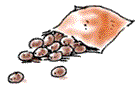
KP, the term for doing kitchen chores and cleanup, originated:
A. As an abbreviation for the army's "kitchen police" A hand-drawn illustration of a small burlap sack lying on its side, spilling out round coins or discs.


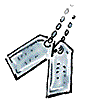
A dog tag, a metal identification badge worn around the neck to distinguish someone in case of injury or death, was called this because:
Two military dog tags on a beaded chain, drawn in a simple hand-illustrated style with dot-and-dash patterns on each tag. B. It resembled the license tag on a dog's collar


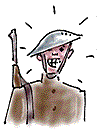
Doughboy, as a term for American soldiers, was first used during the Civil War, but it came into wide use during World War I. It came from:
A. A small, globular, fried biscuit served to sailors that was similar to the buttons on Civil War uniforms
B. The practice of U.S. infantrymen of cleaning their white belts with pipe clay, or "dough"
C. The word adobe, which was used in the Southwest to refer to soldiers who were quartered in adobe buildings
D. All of the above
A simple line-drawn illustration of a soldier wearing a wide-brimmed helmet, grinning widely, and shouldering a rifle.


Return to Puzzle Archive